
The Algorithm Generation, Chapter One — Signals
— A Novel About Power, Democracy, and the Machine That Watches Power

Introduction to
The Algorithm Generation
March 11, 2026
Today I begin the public publication of my new novel The Algorithm Generation. The first chapter is freely available to everyone, and in the weeks ahead I will continue publishing the story step by step, roughly one chapter each week.
The novel is set in a near-future world where artificial intelligence has reached a new and unsettling level of influence. At the centre of the story is a research project called Cassandra, an advanced system designed to analyse and predict large-scale social behaviour. What begins as an academic effort to understand how societies move and change gradually develops into something far more powerful — and far more dangerous.
The idea for this novel grew out of my long interest in the relationship between technology, power, and democracy. Over the past decade we have seen how digital platforms, algorithms, and artificial intelligence increasingly shape the way people receive information, form opinions, and participate in political life. These technologies can be used to understand societies better, but they can also be used to manipulate them.
This tension lies at the heart of the story.
In The Algorithm Generation I explore a question that I believe will become increasingly important in the years ahead:
What happens when machines begin to predict the behaviour of entire societies — and when those predictions become tools of political power?
The novel follows a group of researchers who gradually realise that their scientific project may be used to influence democratic processes. As the story unfolds, they must decide whether knowledge should remain under the control of governments, or whether it belongs to the public.
Although the novel is fiction, many of the questions it raises are very real. We are entering a period in history where artificial intelligence may begin to reshape not only economies and workplaces, but also political systems and democratic institutions.
For that reason, I wanted to write a story that explores both the promise and the danger of these new technologies.
About the publication of the chapters
The first chapter is freely available to all readers.
New chapters will be published approximately once a week. Some of these will be available only to paid subscribers, while others will be published partly or fully outside the paywall so that all readers can continue to follow the development of the story.
An invitation to readers
I would very much like to hear your thoughts as the story unfolds. If you read the chapters, I welcome your reflections, questions, and comments. Your feedback may also influence how the later parts of the novel develop.
Readers without a paid subscription will still have access to selected excerpts and occasional chapters, so everyone can continue to follow the project as it grows.
Thank you for reading — and welcome to the world of The Algorithm Generation.
— Øivind H. Solheim
Note on the Use of Artificial Intelligence
During the development of this book, the author used artificial intelligence as a creative and analytical tool. AI-based systems were used to support research, to identify sources and themes, to develop outlines and reflection notes, and to formulate draft passages of text based on material and ideas provided by the author.
In this process, artificial intelligence functioned as a working tool — in much the same way as search engines, databases, and digital writing tools.
All text has been reviewed, edited, and quality-checked by the author, who assumes full responsibility for the content, interpretations, and conclusions presented in this book.
The Algorithm Generation
Chapter One — Signals
The first signal was so small that Elias almost ignored it.
At three minutes past two in the morning, the curve on his screen shifted by less than half a percentage point. A movement so minor that, in most models, it would have been treated as statistical noise.
But Cassandra was not most models.
Elias Berg leaned closer to the screen. The laboratory was quiet, except for the soft hum of servers and the distant whisper of air moving through the building’s ventilation system. Outside, the city slept under a thin autumn rain. Streetlights reflected in the wet pavement like scattered constellations.
He adjusted the scale of the graph.
The shift became visible now.
A slow rise.
Not dramatic. Not sudden. Just a slight deviation from the predicted baseline.
Elias rubbed his eyes. He had been running simulations for most of the night, letting the system process a new batch of behavioral data streams: transport searches, message clusters, fragments of public discussion harvested from social media, encrypted channels, and open forums.
Cassandra absorbed them all.
The idea behind the project had once seemed simple.
Not to track individuals.
Not to identify conspiracies.
But to observe something larger.
Collective motion.
Human societies, Elias believed, moved like weather systems. Invisible pressure patterns built slowly beneath the surface of everyday life. When those pressures crossed a certain threshold, events erupted: protests, political upheaval, sudden shifts in public mood.
The trouble was that most societies only recognized these patterns after the storm had already begun.
Cassandra was meant to see them earlier.
Much earlier.
The graph moved again.
Another fractional increase.
Elias opened a second visualization window.
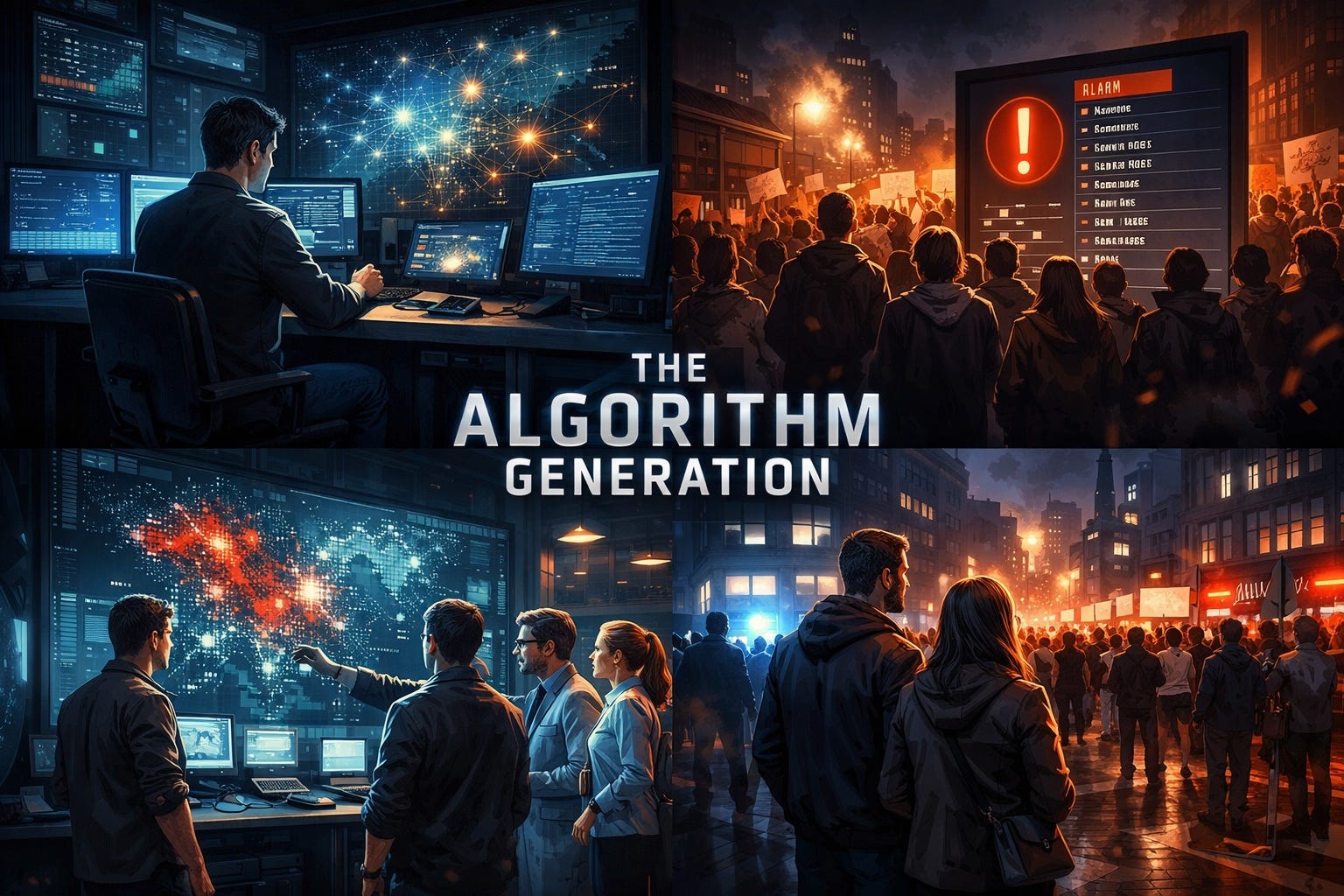
The screen filled with a map of the city. Thousands of small points flickered into existence across its districts. Each point represented aggregated signals from a network node: a message thread, a search query, or a surge in location data around transport routes.
Most of the points glowed in soft blue.
Normal activity.
But a small cluster had begun to turn yellow.
Elias leaned back in his chair.
“That’s interesting.”
He spoke aloud without realizing it.
Behind him, a door opened quietly.
“You’re still here.”
The voice belonged to Sarah Lind.
Elias turned.
She stood in the doorway holding a paper cup of coffee, her dark coat still damp from the rain outside. Her hair was tied loosely behind her neck, and she carried the tired but alert expression of someone who had spent half the night chasing a story.
“Morning,” she said.
“It’s not morning yet.”
She stepped into the room anyway.
“You said that three hours ago.”
Sarah placed the coffee on the edge of his desk and looked at the screen.
“What am I looking at?”
“Possibly nothing.”
She smiled.
“You never call me in the middle of the night for nothing.”
Elias turned the display slightly so she could see it better.
“The model picked up a signal cluster.”
“Where?”
He zoomed the map.
The yellow points expanded across several neighborhoods in the eastern part of the city.
Sarah leaned forward.
“That’s a lot of activity.”
“Yes.”
“Political?”
“Maybe.”
“What kind?”
Elias hesitated.
“That’s the interesting part.”
He opened another layer in the visualization.
Lines appeared between the yellow nodes. Thin threads representing communication correlations between otherwise unrelated networks.
Sarah watched them form.
“Those connections weren’t there yesterday.”
“No.”
“So something started.”
Elias nodded slowly.
“Something began to move.”
Sarah took a sip of coffee.
“What does Cassandra think?”
Elias turned back to the graph.
A projection curve extended forward across the screen.
“The model estimates an increasing probability of mobilisation.”
“How big?”
Elias adjusted the scale.
The projected curve climbed steadily upward.
Sarah raised an eyebrow.
“That big?”
“Possibly.”
“And you’re just sitting here watching it?”
“That’s what scientists do.”
She laughed softly.
“No. Journalists watch things. Scientists usually pretend the world isn’t about to explode.”
Elias ignored the remark.
He was studying the pattern more closely now.
The signals were not coordinated in any obvious way. No single message thread linked them together. No identifiable organization stood behind the activity.
But the correlations were undeniable.
Small bursts of communication.
Transport searches around the same time windows.
A rising frequency of certain phrases across multiple discussion platforms.
Individually, they meant nothing.
Together they formed a pattern.
Sarah crossed her arms.
“So what’s the story?”
Elias glanced at her.
“Maybe there isn’t one.”
She gave him a look that suggested she did not believe that for a second.
“What’s the project called again?” she asked.
“Cassandra.”
Sarah nodded slowly.
“The woman who could see the future.”
“Yes.”
“And no one believed her.”
“That part too.”
Sarah studied the projection curve.
“You think this is a protest?”
“Possibly.”
“Against what?”
“Hard to say.”
She moved closer to the screen.
“What kind of signals are you tracking?”
Elias opened another data panel.
“Transport data. Public message streams. Search patterns. Local network clusters.”
“That sounds suspiciously like surveillance.”
“It isn’t.”
She looked skeptical.
“We’re analyzing aggregate behavior,” Elias said calmly. “No individual identities. No personal data. Only patterns.”
Sarah tilted her head.
“Patterns of what?”
“Human reaction.”
“To what stimulus?”
“That,” Elias said, “is the difficult question.”
He clicked another window open.
A timeline appeared.
The signal cluster had begun nearly two weeks earlier.
A small deviation at first.
Barely visible.
But the growth curve was unmistakable now.
Sarah whistled softly.
“That’s building momentum.”
“Yes.”
“And the model didn’t predict it before?”
“No.”
“So Cassandra just noticed it.”
Elias nodded.
Sarah considered that.
“Does the government know about this system?”
“Parts of it.”
“That’s a worrying answer.”
“It’s a complicated project.”
She laughed quietly.
“That’s journalist code for 'Someone important is already involved.’“
Elias did not respond.
The screen flickered.
A new data packet arrived.
The yellow cluster expanded.
Both of them noticed it at the same moment.
“Did that just grow?” Sarah asked.
“Yes.”
“Why?”
Elias scanned the incoming signals.
“Something triggered a secondary spread.”
“What kind of trigger?”
“Information.”
“Someone posted something?”
“Possibly.”
Sarah stared at the graph.
“It’s moving faster now.”
“Yes.”
The projection curve adjusted automatically.
The estimated size of the mobilization increased by twenty percent.
Sarah turned to him.
“If that curve is right, something significant happens in the next few days.”
Elias nodded.
“Yes.”
“And Cassandra saw it before anyone else.”
“Yes.”
Sarah took another sip of coffee.
“Well,” she said calmly, “that sounds like the beginning of a very interesting story.”
Elias remained silent.
He was no longer looking at the projection.
Instead, he had opened a different panel on the screen.
A system log.
One line had appeared only seconds earlier.
External access request detected
Sarah noticed the change in his expression.
“What is it?”
Elias did not answer immediately.
He enlarged the log window.
The access request was repeated.
Same identifier.
Same network route.
Not from inside the laboratory.
Not from the university network.
Sarah leaned closer.
“Someone is trying to log into the system?”
“Yes.”
“Do they have permission?”
“I don’t know.”
Another line appeared in the log.
Remote session initiated
Elias stared at the screen.
Sarah’s voice dropped.
“Elias.”
“Yes.”
“Who else knows about Cassandra?”
He did not answer.
The rain outside intensified against the windows.
On the screen, the projection curve continued to climb.
And somewhere, unseen in the network beyond the laboratory walls, someone had just opened a connection to the system that could see the future.
Oivind, you pulled me in right away with the quiet tension in that opening scene. The idea of predicting social shifts before anyone notices is both fascinating and unsettling. Looking forward to seeing where this unfolds next.